Physical Address
304 North Cardinal St.
Dorchester Center, MA 02124
Physical Address
304 North Cardinal St.
Dorchester Center, MA 02124
AI, Software & Digital Insights
AI, Software & Digital Insights
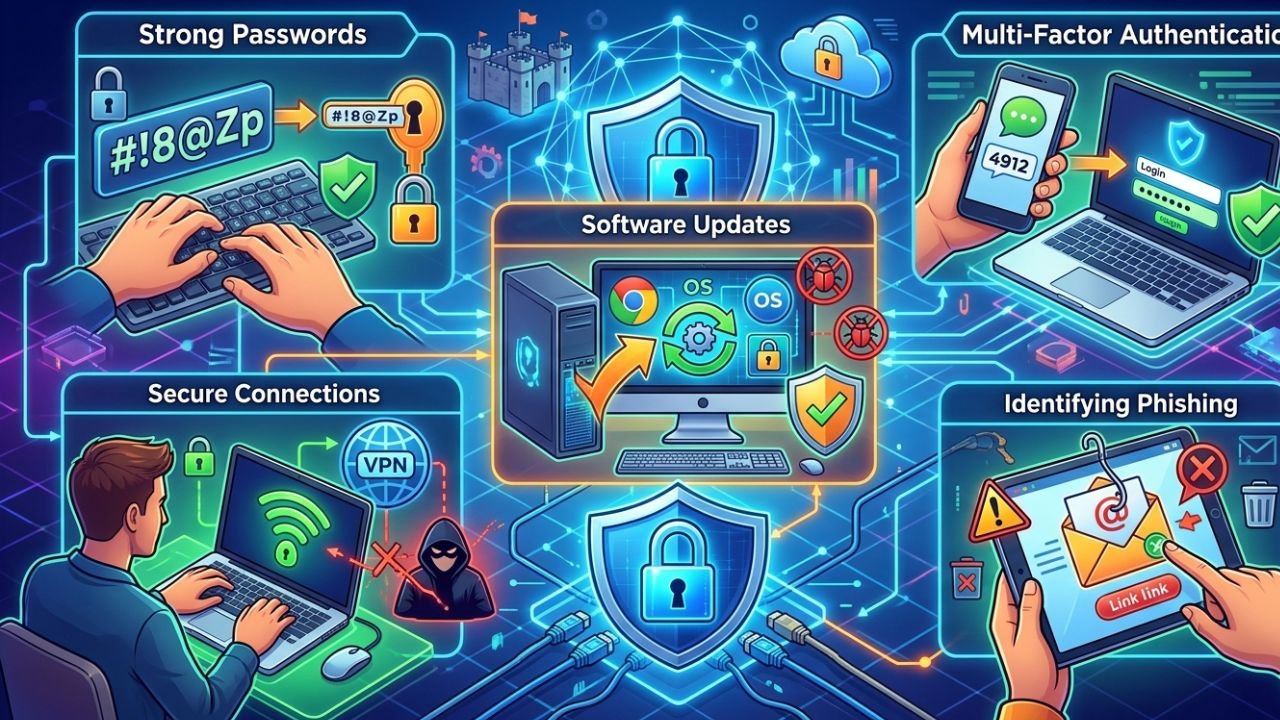
The incident of cyberattacks no longer seems outdated or far. By 2025, 80% of all small business reported at least one cyberattack, the cost of an average US data breach was 10.22 million (IBM, 2025), and the ransomware was mentioned in almost 50 percent of all breaches. Over 80 percent of phishing attacks are now run by AI-generated phishing and the old-fashioned detection tips are out of service. The positive aspect of this is that the majority of attacks are made possible by simple, unavoidable errors. These 15 cybersecurity tips discuss what works in practical in 2026, including real-life examples to students, home users, and businesses.
Security software aids, but those who are attacked stroll through open doors. Most breaches are due to reused passwords, unpatched software, and a single irresponsible click. These tips close those doors right up.
Passkeys either authenticate you with a device PIN or any biometric. None of the passwords are sent through the network thus nothing to steal, phish, or guess remains.
Example: A student was sent a convincing spoofed email by a fake bank and typed in her details on a spoofed page. She only spent hours emptying her account. The attacker would have nothing to use with a passkey. Passkeys are attached to the legitimate domain and are not able to be obtained by the bogus web sites.
| Feature | Password | Passkey |
| Phishable | Yes | No |
| Reusable across sites | Often (bad habit) | No |
| Stored on server | Yes (breach risk) | No |
| Requires remembering | Yes | No |
| Biometric support | No | Yes |
Create Bitwarden or 1Password accounts without a password. Always do not use the same password on two accounts.
SIM-swap attack is susceptible to SMS-based 2FA. A hacker rings your carrier, pretends to be you and puts your number on their SIM. All the codes you get are sent to them.
Example: After a SIM swap, one afternoon a journalist was denied access to her email, social media and crypto wallet. The hacker exploited low key personal information that she had collected on her social public accounts to persuade her carrier.
| 2FA Method | Security Level | Vulnerable to SIM Swap |
| Hardware key (YubiKey) | Highest | No |
| Authenticator app (Authy, Google) | High | No |
| SMS code | Moderate | Yes |
| Email code | Low | Partially |
Have an authenticator app as default. Hardware key is used on email, banking and administration accounts.
Public networks enable any computer sharing the connection to capture unprotected traffic using man-in-the-middle attacks.
Example: One of the financial analysts was on Wi-Fi at the airport who did not use a VPN to access a client portal. One attacker within the same network intercepted his session coyote and logged into the portal without his password. There was exposure of client data prior to detection of the breach.
| Scenario | Without VPN | With VPN |
| Coffee shop browsing | Traffic visible to others | Encrypted |
| Airport Wi-Fi login | Session hijack risk | Protected |
| Hotel network banking | Highly risky | Safe |
| Campus network (students) | Shared, often unmonitored | Encrypted |
Select a no-log VPN company that is audited independently. Both Mullvad and ProtonVPN release third-party audits.
More than 90% of attacks are successful: they use well-known vulnerabilities, which are already patched. The attack occurs between the release of patches and their installation.
Example: In 2017, the WannaCry ransomware virus had a high infection rate of 200,000 jobs in 150 countries, including UK hospital networks. The patch released by Microsoft was two months earlier. All systems that were not patched were breached. All of the patched systems were secure.
| Update Type | Recommended Action |
| Operating system | Enable automatic updates |
| Browser | Auto-update or check weekly |
| Apps | Enable auto-update in app store settings |
| Router firmware | Check admin panel monthly |
| High-severity patches | Apply within 30 days |
| Actively exploited zero-days | Apply within 7 days |
The old phishing detection tips, examine the spelling and unusual formatting, are no longer effective. AI utilities create email messages that are completely in the correct language, tone, style, and even allude to actual running projects.
Example: One of the finance managers got an email, which looked like a message sent to her by the CEO of the organization, mentioning a real project by its name and demanding a wire transfer of 47000 dollars. The email was made by producing posts in LinkedIn groups and press releases as inputs to an AI writing program. The transfer was carried out.
| Old Detection Signal | Still Reliable in 2026? |
| Spelling and grammar errors | No |
| Generic greeting (“Dear User”) | Sometimes |
| Suspicious sender domain | Partially |
| Unexpected urgency | Yes |
| Unusual request type | Yes |
| Out-of-band verification failed | Yes |
Always confirm any suspicious financial or other credential requests by calling the requestor at a number that is already in your address book, rather than the one given in the email.
Ransomware is a malware that encrypts your files and asks to pay to unlock them. The attacker can only access a clean copy that you can use as leverage.
Example: A freelance designer lost five years of client files to ransomware. She had cloud backups, but they were synced to her device, and were encrypted with the rest. The external drive would have been unreachable without being plugged in. She had paid the ransom without being certain of rescuing.
| Backup Component | What It Means |
| 3 copies | Original plus two backups |
| 2 storage types | Example: external drive plus cloud |
| 1 offline copy | Unplugged drive, off-site storage |
| Test frequency | Restore a file quarterly to verify |
A malware on your connected device cannot access an offline copy.
The gateway to all your devices is your router. Hacked router puts an attacker between you and all the sites that you do visit.
Example: Researchers found millions of home routers running default admin credentials years after purchase. In one case, an attacker accessed a family’s router and intercepted banking credentials over several weeks before discovery.
| Router Security Step | Why It Matters |
| Change default admin credentials | Default passwords are publicly known |
| Update firmware | Patches known vulnerabilities |
| Use WPA3 encryption | Stronger than WPA2 |
| Disable WPS | Has documented brute-force vulnerabilities |
| Create a guest network | Isolates smart devices from sensitive ones |
Normal email transits several servers. Attachments may be hacked, saved on uncontrollable infrastructure, and directed outside of your intended recipients.
Example: Year after year a law firm emailed their clients contracts. The account with a weak password was being quietly copied with correspondence over the years. Trade secrets and trade identities were also leaked as well as settlement information, which were confidential. Silent exfiltration would have been prevented by the means of an encrypted sharing platform allocating access controls and auditting logs.
| Sharing Method | Encrypted | Access Control | Audit Trail |
| Regular email | No | No | No |
| Email with TLS | In transit only | No | No |
| Encrypted file sharing platform | End-to-end | Yes | Yes |
| Consumer cloud (unmanaged) | Storage only | Limited | Limited |
Most apps ask permissions way beyond the scope of their application. Apps often harvest location data, access to microphone, and address books with no justifiable cause as to why they require it.
Example: A downloadable free flashlight app was installed more than 50 million times and has been sending GPS locations and address books to third-party servers. Majority of the users had allowed permissions without accessing them.
| Permission | Legitimate Use Case | Red Flag |
| Camera | Photo/video apps | Flashlight, calculator apps |
| Microphone | Call, voice apps | Shopping, weather apps |
| Contacts | Communication apps | Games, tools |
| Location | Navigation, maps | Unrelated utilities |
| Storage | File management | Simple single-function apps |
Delete unused apps. Cancel options not related to core functionality. Only install in official stores.
“Zero Trust” implies that there is no automatic trust of a user or devices. Each access request is checked each time when the user is either outside or inside the network.
Example: One of the marketing firms found out that their past contractor had continued access to their project management site nine months after the exit. The contractor downloaded client lists and pitch materials without a review of access, since there was no such process in place. Soon after, two clients of the agency were lost to a competitor.
| Zero Trust Principle | Practical Action |
| Least privilege access | Employees see only what their role requires |
| Always verify | Require re-authentication for sensitive actions |
| Log all access | Flag unusual activity early |
| Review regularly | Audit access rights when roles change |
| Never trust by default | Apply to devices and users equally |
Voice cloning is able to clone the speech of an individual based on a matter of few seconds of audio. Video deep fakes have become good enough to be used to mislead individuals during a live interview.
Example: An employee of a Hong Kong finance company was a part of a video conference that seemed to incorporate the CFO of the company and a couple of other staff members. All the participants were a deepface. On the instructions given during that call, he approved a transfer of $25 million.
| Deepfake Type | How It Is Used | Defense |
| Voice cloning | Phone fraud, fake CEO calls | Call back on a known number |
| Video deepfake | Fake video meetings | Establish a code word |
| AI-written messages | Phishing, impersonation | Out-of-band verification |
Develop a common jargon with family and coworkers to any money-related request or account access.
Training annually generates records on compliance but not change in behavior. Firms that use monthly micro-training and quarterly phishing simulation programs have as many as 70% fewer successful phishing attacks as compared to those who only use annual programs.
Example: A local credit union had conducted training on a yearly basis over 5 years. There was little movement in the phishing click rates. Switching to monthly, 5-minute sessions and quarterly, simulated phishing email, their click rate decreased to 6% in eight months, a reduction of 24.
| Training Approach | Effectiveness |
| Annual classroom session | Low |
| Annual online module | Low to moderate |
| Monthly micro-training (5-10 min) | High |
| Quarterly phishing simulations | High |
| Role-specific training (finance, HR) | Highest for targeted roles |
As a home user, remind yourself monthly to read a security article or complete a free phishing quiz offered by Google or CISA.
Your email and password could be spread in breach databases as we speak, being used in credential stuffing attacks on hundreds of sites.
Example: A small business owner found that he had 14 different breach databases on which his email address and an old password are used after he conducted a check on haveibeenpwned.com. He had used the same password on 6 accounts that were active. It took 20 minutes to change on each one of them. Stuffing attack with the aid of that password would in just a few minutes have compromised all six.
Go to hasibeenpwned.com and verify all the email addresses that you employ. Breach notification has to be enabled. Should your credentials show up, change the compromised password as soon as possible and on any other account with which it was used.
There has been fourfold SCB in recent years. Your security can be good, and that of a vendor who has access to your data is weak.
Example: A medical practice deployed an appointment scheduling system (third-party) that was breached in 2024. The name of the patients, their telephone numbers and the type of appointments were disclosed. The clinic had not checked the security certifications of the vendor or enquired about how the vendor handled their data.
| Question to Ask Vendors | Why It Matters |
| Do you hold SOC 2 or ISO 27001 certification? | Confirms independent security audit |
| How is our data encrypted at rest and in transit? | Protects against breach exposure |
| What is your breach history? | Reveals past failures |
| What access do you actually need? | Limits blast radius if compromised |
| What is your incident response process? | Determines how fast you are notified |
Review vendor access annually. Build security expectations into contracts.
The average times to detect and contain most breaches is 241 days (IBM, 2025). A written plan reduces that time by a big margin as no decisions are taken straight into it but they will have been made beforehand.
Example: In 2024, a ransomware assault was failed upon by a small accounting company that had no record of a response plan. The initial six hours of staff was wasted on discussing with whom to call, whether to pay the ransom, and how to inform clients. A rival company that came under a similar attack the same month had an established written plan, segregated the affected systems, retrieved the data using an offline backup, and informed the clients in 24 hours. The variance in the recovery cost was great.
| Incident Type | Key Response Steps |
| Account compromise | Revoke sessions, reset credentials, check audit logs |
| Ransomware | Isolate device, restore from offline backup, report to authorities |
| Device theft | Remote wipe, change all passwords stored on device |
| Data breach | Identify scope, notify affected parties, review access logs |
| Phishing click | Report to IT, reset credentials, check for unauthorized activity |
Conduct top-table exercise at least once a year. Discuss a scenario with your group or family to make the plan well-known prior to necessity.
| Threat | Best Defense | Priority |
| Phishing (AI-generated) | Out-of-band verification, email filtering | Critical |
| Weak or reused passwords | Passkeys, password manager | Critical |
| Account takeover | Authenticator app or hardware key | Critical |
| Ransomware | Offline 3-2-1 backups | Critical |
| Public Wi-Fi interception | VPN | High |
| Unpatched software | Automatic updates | High |
| Deepfake scams | Code word, callback verification | High |
| Credential exposure | Have I Been Pwned, unique passwords | High |
| Router vulnerabilities | Firmware update, WPA3, changed defaults | High |
| Supply-chain attacks | Vendor vetting, minimal third-party access | Medium |
| App permission overreach | Quarterly permission audit | Medium |
University networks are dense networks with thousands of users sharing a common infrastructure. Students have a unique profile of threats which is not adequately addressed by general advice.
| Student-Specific Risk | Recommended Action |
| Campus Wi-Fi (shared network) | Use a personal VPN for all browsing |
| Student email (high-value target) | Enable 2FA immediately |
| Library and lab computers | Always log out, never save credentials |
| Academic browser extensions | Review permissions before installing |
| Financial aid phishing | Verify any aid-related email through official portals |
| Peer file sharing | Scan all downloads before opening |
| Action | Time Required | Cost |
| Enable 2FA on email and banking | 10 minutes | Free |
| Install a password manager | 20 minutes | Free (Bitwarden) |
| Check haveibeenpwned.com | 5 minutes | Free |
| Enable automatic updates | 5 minutes | Free |
| Set up a VPN | 15 minutes | Low monthly cost |
| Change router admin password | 10 minutes | Free |
| Create an offline backup | 30 minutes | Cost of external drive |
Here is the streamlined version continuing from the Top 15 Tips section:
High-value targets are students. The university email address is one that links with financial aid sites, tuition sites, scholarship applications, and year records of your personal history. A single compromised account can cause a ripple effect to all of the services associated with the account.
Turn-on 2FA on your school email account when you get your account. Do not use SMS, use authenticator app. The email in which students are notified that they have gone to the university is usually used by them to subscribe to dozens of external services, the violation of which gives them access to all that lies in the email.
Phishing attacks targeting students peak at expected intervals: financial aid payment dates, scholarship applications and test time when multitasking occurs. Do not click a link on an email to get to either your student account or your financial aid account. Enter the URL or a bookmark.
Hundreds of active users may be on the same subnet of a dormitory network. Any networked device that is not secured can be identified by a student with a simple network scanning gadget around them.
| Student Risk | Recommended Action |
| Campus Wi-Fi | Use a personal VPN for all browsing |
| Student email | Enable 2FA immediately |
| Library computers | Always log out, never save credentials |
| Browser extensions | Check permissions before installing |
| Financial aid emails | Verify only through official portals |
| Textbook download sites | Use only verified academic sources |
The typical home network by 2026 is over 20 devices connected. Different models of Smart TVs, thermostats, cameras, gaming consoles, and phones are all connected to the same router. Every piece of equipment can be a point of attack.
Create a primary network for computers and phones. Create a separate guest network for smart home devices. A compromised smart TV on a segmented network cannot reach your laptop. On a single shared network, it can reach everything.
| Smart Device Risk | Action |
| Default credentials | Change immediately after setup |
| Infrequent firmware updates | Check monthly in the device app |
| Cloud-connected cameras | Use strong passwords and 2FA |
| Voice assistants | Review privacy settings, limit data sharing |
| All IoT devices | Isolate on guest network |
| Action | Time Needed | Cost |
| Enable 2FA on email and banking | 10 minutes | Free |
| Install a password manager | 20 minutes | Free (Bitwarden) |
| Check haveibeenpwned.com | 5 minutes | Free |
| Enable automatic updates | 5 minutes | Free |
| Set up a VPN | 15 minutes | Low monthly cost |
| Change router admin password | 10 minutes | Free |
| Create an offline backup | 30 minutes | Cost of external drive |
Small and mid-sized businesses hold more valuable data, have more attack surface, and often lack dedicated security staff. Three actions deliver the highest return.
Run an access audit first. List every account, integration, and credential with access to your systems. Revoke anything not actively in use. Former employees, forgotten API keys, and unused contractor accounts are among the most common entry points in business breaches.
Get cyber insurance. The average cyberattack costs a small business between $120,000 and $254,000. Cyber insurance covers breach response, legal fees, and business interruption losses.
| Coverage Area | What It Typically Covers |
| Breach response | Forensics and notification costs |
| Legal fees | Regulatory defense and client claims |
| Ransomware | Ransom negotiation and recovery |
| Business interruption | Lost revenue during downtime |
Vet your vendors annually. Supply-chain breaches have quadrupled in recent years. Before renewing any vendor contract involving data access, ask for SOC 2 certification, encryption practices, breach history, and incident response documentation. Build security requirements into contracts as enforceable clauses.
No security software can make up against an individual who participates in sharing a password or impulsive clicking. It is the human factor, and the most susceptible factor at the same time the most amenable.
Create an environment in which it is not punished to report an error but rather be encouraged. A reported employee that clicks a suspicious link often within minutes affords your team time to act. He who conceals it one week, provides the attacker with a week. When done every week (monthly), micro-training and quarterly phishing simulation dramatically reduce successful attacks by up to 70 percent of annual-only programs.
In the case of home users, the same is to remain informed at all times. Create a subscription to a security newsletter. Check haveibeenpwned.com quarterly. These practices require a few minutes and leave a perceivable impact.
In 2026, cybersecurity is not about the high-priced tools. It concerns bridging the gaps that are in fact exploited by attackers. Passkeys over passwords. Authentic two-factor authentication via SMS codes. The backing with offline knocks at hope. Stemming perpetual training around annual checkboxes.
It is the same whether you are a student on a campus network, whether there are a dozen connected devices at home, or whether you were just a business owner who has client information and you need to protect the information associated with your network. Begin with the ones that are free and take a couple of minutes. Build from there. Majority of the attackers seek the simplest target. Have that one on some other body.