Physical Address
304 North Cardinal St.
Dorchester Center, MA 02124
Physical Address
304 North Cardinal St.
Dorchester Center, MA 02124
AI, Software & Digital Insights
AI, Software & Digital Insights

The majority of bloggers and the owners of the sites waste many hours trying to create some content only to realize that their articles fail to hit the first page on Google. It is seldom the quality of writing that is an issue. The actual problem in most instances began way back before the publication of the article. It begins with the choice of key words. An article that is well-written but has a wrong keyword can fail to develop traffic after months unsuccessfully. In the meantime, a relatively efficient article with the appropriate keyword can gain visitors regularly and gain authority in the long run. This is the reason why learningHow to Find Low Competition Keywords With High Traffic has become one of the most sought after SEO skills in 2026.
There has been a revolution in search environment. Google currently uses search intent, topical authority, user experience, and expertise to evaluate content. Meanwhile, AI-driven search engines like ChatGPT, Gemini, Claude, and Perplexity are gaining significance as sources of traffic. These sites favor information that gives explicit solutions, valuable experiences and exhaustive discussion of the matter. Because of this, key(word) research is now not just finding search volume. It is concerned with discovering possibilities.
Within this guide, you will discover how successful SEO professionals can find keyword opportunities, unearth secret traffic, and construct content strategies to produce long-term growth.
The easiest method of identifying low competition keywords is to determine search terms that are always needed, user intent, and low competition in search results. Rather than using general keywords that are dominated by huge websites, narrow down to specific searches that can be found by the user seeking more specific answers or solutions.
The biggest mistake made by many owners of websites is that they pursue the highest search volumes that are present. Although high-volume keywords can appear appealing, they are usually dominated by reputable websites that have well-established backlink profiles and decades of trust. Hacking smarter would be to focus on the keywords where ranking is feasible and traffic potential is not low.
In assessing opportunities of keywords, consider more than just search volume. Take into account the level of key phrase difficulty in ranking, the presence of current content that completely conveys the intent to the users, and other visible gaps in search results that your content can handle.
| Ranking Factor | Ideal Situation |
| Search Volume | Consistent demand |
| Competition | Low or moderate |
| User Intent | Clear and specific |
| Content Gap | Existing content is incomplete |
| Ranking Websites | Smaller or weaker competitors |
| Topic Relevance | Closely related to your niche |
The combination of all these factors will allow even a comparatively new site to compete successfully.
Low competition keywords are search queries where relatively few websites have created highly optimized content. Since there are not many websites aggressively fighting over such searches, it is easier to rank them in comparison with larger and more competitive keywords.
The largest fallacy about low competition keywords is that they are always of low traffic. This is not really the case. There are so many opportunities of key words that have hundreds and even thousands of searches monthly and are fairly easy to become top of. The dilemma is on how to find them before they are found by competitors.
Debate over a general keyword and a narrower variant. Such words as SEO are highly competitive since they are targeted by big corporations, software businesses, and marketing websites. Nonetheless, the term like SEO strategy to meet new travel blogs is far more specific, and has a smaller audience. Due to the reduced numbers of websites that concentrate on that particular subject, competition becomes minimal.
One more fact that makes these keywords worthwhile is that often they will be of great interest to targeted traffic. A person searching in a general term does not necessarily have to do more than merely searching a subject. When a person is seeking a detailed phrase, he or she tends to be goal oriented. This implies that visitors that come into the site using low competition keywords tend to be more active and they will be more likely to act.
| Broad Keyword | Low Competition Alternative |
| SEO | SEO strategy for travel blogs |
| Blogging | Blogging mistakes beginners make |
| Email Marketing | Email marketing for fitness coaches |
| Affiliate Marketing | Affiliate marketing without social media |
| Content Marketing | Content marketing plan for local businesses |
Individually, these alternatives can be less frequently searched, but they frequently can be easier to optimise and more qualified traffic is brought in.
Even the most successful websites seldom rely on one high-volume keyword. Rather, they accumulate traffic ranking hundreds of small opportunities which, when combined, create massive visibility.
Keywords research may seem easy on the face of it, but this can be where most of the website owners make expensive error. Majority of failures take place due to the incorrect metric that bloggers are concentrating on or due to disregarding old advice.
One of the most typical pitfalls is to select keywords solely on the basis of search volume. It can get very exciting to see a keyword have 20,000 searches monthly, especially when one is a new blogger. Search volume on its part is, however, not much in giving information on ranking potential. When the first page contains such giants as publishing companies, SaaS, and industry leaders, ranking becomes incredibly challenging.
Overreliance on the difficulty of the keywords is another error. Though these scores may give useful information, they are not the complete picture. There are key words which seem challenging based on the SEO tools yet have weak content in the results of the search. Other keywords seem simple yet they are controlled by well-established brands.
Search intent is also disregarded by many bloggers. A keyword can be appealing to traffic, but should your content be the opposite of what the user is looking to find, the ranking will not be easy. Search engines are more and more rewarding the content that also complies with the expectations of users.
The creation of the content not belonging to the main niche of a website is perhaps the biggest error. Google does have an increased focus on topical authority. Placing random content on your site simply because it seems easy to rank can undermine the overall expertise indicators of your site.
| Mistake | Why It Hurts Rankings? |
| Chasing search volume only | Competition is often too high |
| Ignoring search intent | Content fails to satisfy users |
| Copying competitors | Hard to outperform established sites |
| Publishing random topics | Weakens topical authority |
| Trusting KD scores blindly | Misses real opportunities |
| Ignoring content quality | Better content wins rankings |
The most effective SEO strategies are those ones that are opportunity-oriented, as opposed to number oriented. A keyword whose search is 300 in a month with a strong competition can still bring about far better results than one whose keyword starting 10,000 search and with a strong competition around it.
The current state of SEO professionals rates keywords significantly more than a couple of years past. Conventional conventional search relied a lot on the search volume and difficulty of the keyword. As much as these metrics continue to be important, they no more fully describe the picture. Opportunity is the main focus of modern research in key words.
A keyword opportunity would be present when the users are in the mood of searching, the content available is not meeting the users to the full extent and the competition is not too stiff. Such a combination makes the optimal ranking environment.
A simple opportunity framework might be useful in thinking of understanding how to select keywords.
Search Demand + User Intent + Weak Competition + Content Gap = Ranking Opportunity
This is a formula that illustrates a crucial fact. One of the baits is search volume. A Keyword which has moderate demand and less competitive power is likely to have better performance as compared to highly searched keyword with mighty competitors.
To illustrate, consider two keywords.
| Factor | Keyword A | Keyword B |
| Search Volume | 12,000 | 700 |
| Competition | Very High | Low |
| Content Gap | Small | Large |
| Ranking Potential | Low | High |
The vast majority of beginners prefer using Keyword A due to the high search. The Keyword B would be preferred by experienced SEO professionals since chances of ranking are high. Traffic is a factor since you must be able to get the visibility. This attitude change is among the most vital lessons in today SEO.
Surprisingly one of the best keyword research plans is not very complicated. Rather than analysing with keywords, analyse with problems.
Individuals will hardly search with the SEO terminology. They explore in the search to find a solution to a problem, to answer a question or to reach a goal. The point of on-line search engines is to matching solutions with user needs, and that is why often, audience problems can give more promising opportunities by using search engine ideas than by using brainstorming.
An illustration of this is a new blogger who might not be searching with the term SEO. Rather, they will be more inclined to find such expressions as why is my blog not getting traffic or how do I rank my first article. Such searches indicate the underlying issues which the users are attempting to solve.
When you target problems, long-tail keyword opportunities are also likely to be discovered without the need of much effort on your part since most competitors look past them. It is also a strategy that allows one to develop more useful content as your articles are no longer written around the key words.
The other advantage is that AI search engines are becoming more predisposed to content that directly addresses the questions. When ChatGPT, Gemini, or Perplexity are asked a question by the user the system is inclined to give out information that resolves an issue in the real world as opposed to information that is just optimized with keywords.
| User Problem | Potential Keyword Opportunity |
| Blog traffic is dropping | Why is my blog traffic decreasing |
| Content is not ranking | How to improve keyword rankings |
| No organic visitors | SEO tips for new websites |
| Low conversions | How to increase website conversions |
| Poor engagement | Why visitors leave my website |
The more related your content is to problems of the audience, the higher the likelihood of gaining qualified traffic and gaining high rankings.
Topical authority is one of the largest ranking criteria in current SEO. The search engines would like to see that a web site has mastered a topic as opposed to articles they can access alone on different topics.
Successful sites instead of ranking in dozens of irrelevant keywords create clusters of content around a primary subject. This assists in the search engines to know what the web site specializes in and builds up trust (in the long run).
To illustrate, in case your site is about blogging, you would want to write about various topics related thereof as opposed to putting a single article on SEO after which you would proceed to the entirely different topics.
| Core Topic | Supporting Articles |
| Blogging SEO | Keyword Research |
| Blogging SEO | Search Intent |
| Blogging SEO | Internal Linking |
| Blogging SEO | Content Planning |
| Blogging SEO | AI SEO Optimization |
| Blogging SEO | Technical SEO Basics |
The articles reinforce each other. Internal connections bring issues together, user interaction is enhanced, and the search engines start to accept the site as a reputable resource in that industry.
Another role that is beginning to be played by AI-driven search is topical authority. The probability that AI systems refer to a website, which exemplifies a profound level of knowledge in a whole area of study as opposed to those, which only touch on the superficial aspects of the topic.
Beyond individual keywords, when developing a content strategy, have other options in mind. Concentrate on becoming the best source on a particular subject. As time goes on, it becomes much easier to rank with larger keywords in this way.
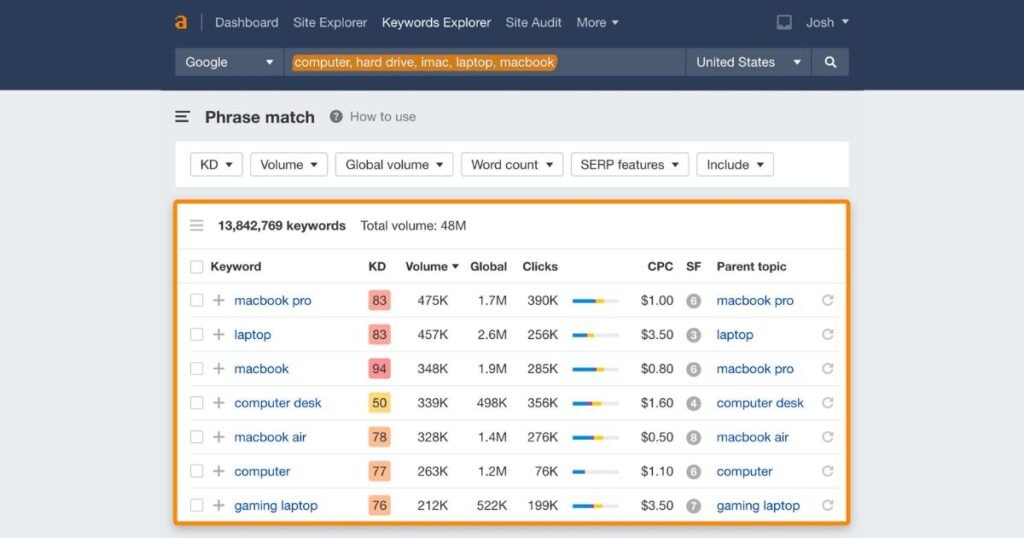
A lot of individuals believe that they require costly SEO software to reveal lucrative key phrases. Although, unquestionably, certain premium tools will help hasten the process, Although certain premium SEO tools for beginners will help hasten the process, the most interesting keyword suggestions may be located within Google.
Every day Google gathers billions of searches. Consequently, several of its in-built features will give some insight into what users are actively searching. The benefit of a self-administered Google is that the data is based on actual search related behavior and not the estimated data produced by third-party tools.
Google Autocomplete is among the simplest to begin with. Google recommends related searches through popularity and relevance, when you start typing a search query. Such propositions frequently demonstrate the long-tail opportunities that most of the competitors do not pay attention to.
The People also ask feature is also worthwhile. All questions shown there are actual user concerns. Whenever Google displays the same question in several searches, that is likely to mean that the searcher is interested. Such questions might be made into article pieces, questions on the FAQs list, or even appear on their own as blog posts.
Another layer of discovery of a key word is via related Searches at the bottom of search results. Such words are used to increase topical coverage as well as expose more angles that are of interest to searchers.
| Google Feature | SEO Benefit |
| Autocomplete | Reveals real searches |
| People Also Ask | Shows common questions |
| Related Searches | Expands keyword ideas |
| Google Trends | Identifies emerging topics |
| Search Results | Helps evaluate competition |
The use of these free resources continues to be relevant to many experienced SEO practitioners since they unveil useful key opportunities that cannot be identified by automated tools.
Most of the marketers are of the notion that high search volume low competition keywords are difficult to come by. Although they are not as common as those of typical low competition keywords, they are by no means completely non-existent.
The difficulty lies in finding them and they are ahead of the pack.
Monitoring the emerging trends is one of the best ways to identify such opportunities. There are new products, technologies, platforms, and developments in the industry that usually create search demand before bigger websites start targeting those relevant to such search phrases.
Locally based websites are consideration stimulating. Reddit conversations, Facebook groups, industry forums, YouTube comments, and niche communities often present the manifestation of increasing interests before key tool query lists show that there is considerable search volume.
The other measure is to attack underserved subtopics. Numerous big sites are devoted to general topics and disregard extremely narrow questions. These neglected searches are capable of drawing a lot of traffic but are also quite easy to rank.
| Source | Opportunity Type |
| Google Trends | Emerging searches |
| User frustrations | |
| Industry Forums | Untapped topics |
| YouTube Comments | Audience questions |
| Product Reviews | Content gaps |
| Facebook Groups | New discussions |
When choosing between tools, a detailed comparison like Ahrefs vs SEMrush can help you decide which platform suits your workflow and budget. Effective keyword research is sometimes about recognizing the prospect and making it before others realise others are interested.
One of the most powerful SEO tools that can be used is long-tail keywords. A long-tail keyword is a narrower search term that usually consists of more than one word, and demonstrates a definite user intent. Calculation of individual search volumes can be less, but long-tail keywords usually give better results since they bring in pertinent visitors.
Take the example of a wide keyphrase like SEO and a longer-keyphrase like how to find low competition keywords with high traffic. The initial keyword might imply various things. The latter keyword makes it clear as to what the user wants.
Due to the specificity of long-tail keywords, competition is less. It is also easier to assess the content in accordance with the user intent using search engines.
| Broad Keyword | Long-Tail Alternative |
| SEO | SEO strategy for new blogs |
| Blogging | Blogging tips for beginners |
| Content Marketing | Content marketing for local businesses |
| Email Marketing | Email marketing for coaches |
There are several advantages to long-tail keywords:
In the case of relatively new websites, the use of long-tail keywords tends to give a quickest path towards natural organic growth.
Content gap analysis can help reveal ranking opportunities one of the easiest ways to do it. The content gap is created when the current ranking pages cannot provide answers to user queries that are either not satisfactory. The search engines desire to give the best possible solution to all queries. Where there is a deficiency in current content there are opportunities.
Firstly, look at the first pages of your target keyword. Seek structural, depth, freshness, and example weaknesses and general helpfulness.
Ask yourself:
Ranking of many websites is due to lack of an alternative. Having a more comprehensive and useful resource can be an edge of competence upon publication.
| Content Gap | Opportunity |
| Outdated statistics | Provide updated data |
| Missing examples | Add practical demonstrations |
| Weak formatting | Improve readability |
| Thin content | Create comprehensive guides |
| No FAQs | Address additional questions |
It is not aimed at imitating competitors. The idea is to come up with something really better to use.
One of the best-taught SEO skills in 2026 will be learning hHow to Find Low Competition Keywords With High Traffic. You should not compete with influential sites to capture general keywords, instead you should seek opportunities where there is demand but competition is viable. With knowledge of low competition keywords, search results analysis, focus on long-tail opportunities, and discover high search volume low competition keywords, you will be able to develop a sustainable content strategy driving traffic in the long run.
The websites that are constantly increasing are not the ones targeting the largest keywords. It is they who determine content gaps, address user issues, and produce worthy resources that are relied upon by search engines and AI platforms. With topical authority, AEO principles and GEO optimization, low competition keyword research is turned into a long-term organic growth system, which can be repeated.
Q1. How long does it take to rank for low competition keywords?
Majority of web sites start ranking levels in a few weeks to a couple of months depending on the rivalry, content quality, and authority of the websites.
Q2. Can beginners rank for low competition keywords?
Yes. Indeed, new websites have a good starting point of low competition keywords since it offers promising ranking chances.
Q3. Are low competition keywords worth targeting?
Absolutely. Competitive Multiple low competition rankings tend to bring a lot of traffic together than one highly competitive keyword.
Q4. How many keywords should one article target?
Articles are most effective with one primary keyword with a range of secondary keywords closely related.
Q5. Should I focus on search volume or competition?
Both a balance is desirable. Nevertheless, potential and user intent tend to be important factors to consider, rather than search volume itself.